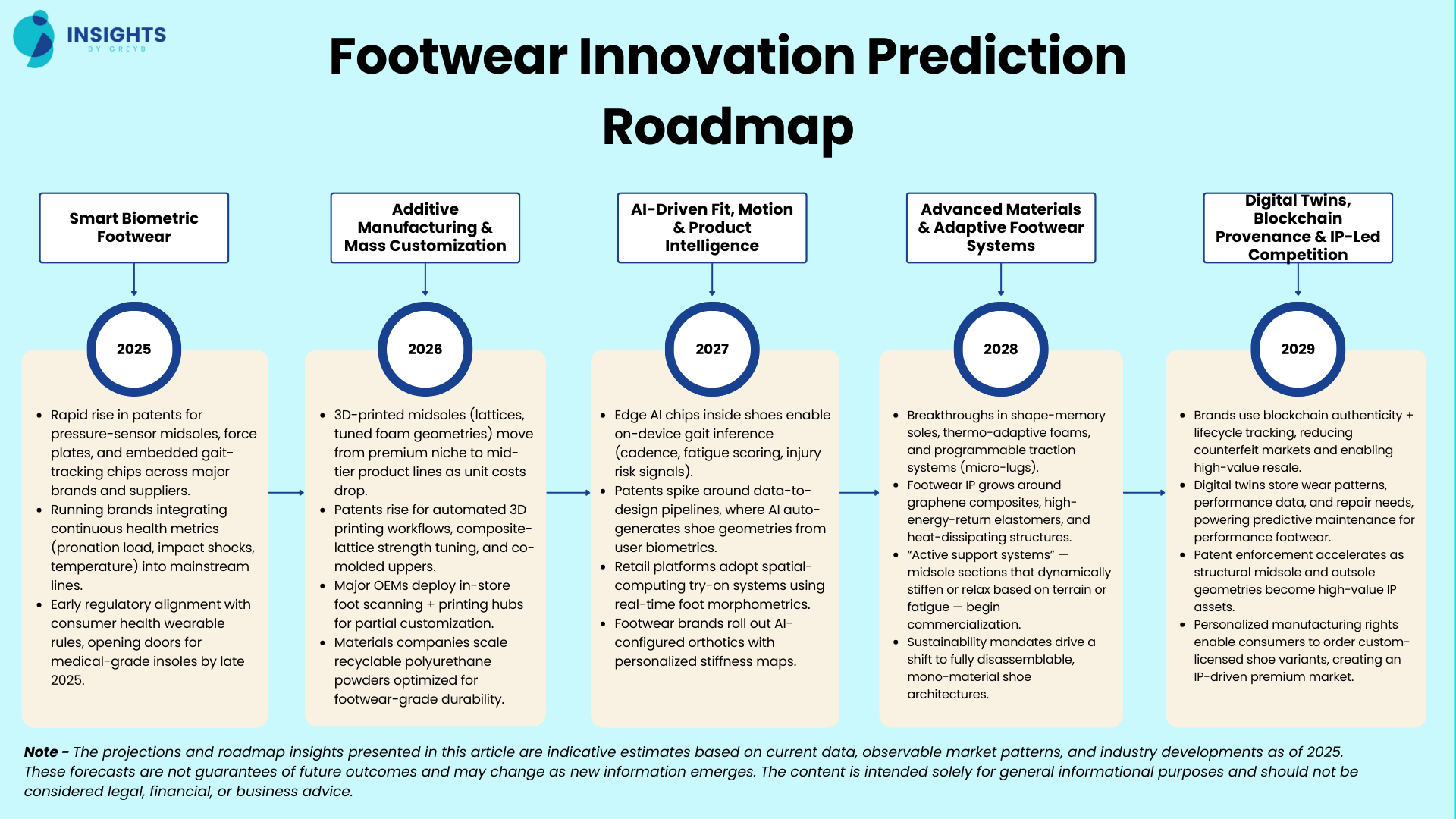
In the world of athletic footwear, a subtle but significant transformation is taking place one driven as much by technology as by design. Recent headlines have highlighted breakthroughs ranging from ultra-responsive midsoles to bio-based performance materials, signaling how innovation is reshaping what modern sports shoes can be.
Behind these visible trends lies a much broader industry shift. Footwear companies are increasingly rethinking how shoes are conceptualized, engineered, and manufactured. Advanced foams and composite structures are replacing conventional materials, automated knitting and 3D-printing are reducing waste, and data-driven design is enabling more precise performance customization than ever before.
Sustainability targets are also pushing brands toward recycled polymers, solvent-free processes, and circular manufacturing models.
This rapid evolution is reflected in the patent landscape, with over 130,000 footwear-related patents filed globally. Leading players like Nike, Adidas, Asics, Anta Sports, Skechers, Puma, and Li-Ning are actively driving innovation in materials, performance technologies, and modern manufacturing.
Footwear brands face rising pressure to adopt recyclable, bio-based, and low-carbon materials. However, sustainable materials often compromise durability, abrasion resistance, water-proofing, or long-term comfort. Finding eco-materials that match synthetic leather, foams, and rubbers is a major barrier driving significant R&D and patent activity in polymers, adhesives, and manufacturing processes.
Consumers increasingly expect shoes tailored to foot shape, arch support, gait, and activity type. Mass production struggles with personalization, leading to discomfort, injury risks, and high return rates—especially in e-commerce. This drives innovation in smart insoles, foot-scanning technologies, responsive cushioning, and biomechanical design, reflected in a growing cluster of patents around fit-optimization systems.
A typical shoe has 50–70 components, requiring stitching, molding, bonding, and assembly. Manual labor dependence, long lead times, and reliance on overseas suppliers create inefficiencies. Disruptions (logistics, labor shortages, geopolitical instability) severely impact production. As a result, automation, 3D knitting, additive manufacturing, and modular shoe architectures are rising areas of patent filing.
Over 22 billion pairs of shoes are produced annually, most ending up in landfills because they contain complex material combinations (rubber, EVA, leather, textiles, adhesives) that are almost impossible to recycle. Regulations and consumer expectations push brands to develop recyclable soles, disassemblable shoe structures, and circular design technologies—driving a surge in IP around mono-material soles, dissolvable adhesives, and mechanical fasteners.
Footwear is among the most counterfeited consumer goods worldwide. High-value sports and luxury brands lose billions due to replicas that mimic designs, logos, and comfort technologies. This creates demand for IP protection technologies such as embedded authentication tags, blockchain-based track-and-trace systems, and unique material signatures—leading to patent filings in anti-counterfeit markers and traceability systems.
Developing next-gen cushioning foams, energy-return systems, waterproof membranes, or sensor-enabled footwear requires advanced materials science, testing equipment, biomechanics expertise, and long development cycles. Smaller manufacturers struggle to keep pace. Patent competition is intense around soles, foams, propulsion plates, adaptive systems, and smart footwear electronics, raising barriers to entry.
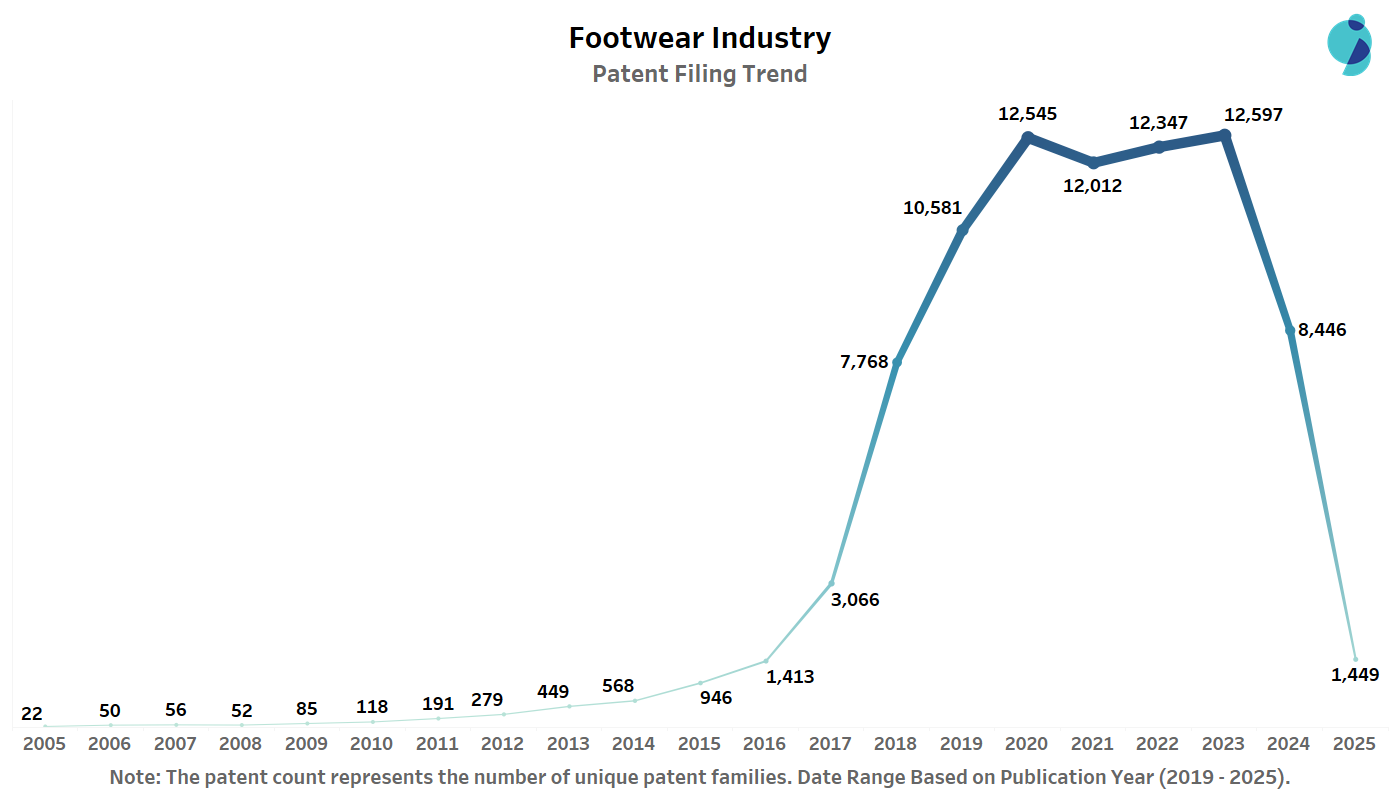
Patent filings in footwear surged from just hundreds in the early 2010s to over 12,000 annually by 2023—reflecting breakthrough innovations in smart footwear, sustainable materials, performance tech, and manufacturing processes.
About the recent trend? Patent applications take up to 18 months to publish, so the latest filings are still working through the system. The innovation pipeline remains robust—the question is who’s leading it and where.
Major players continue aggressive patent activity across smart textiles, biomechanical design, and sustainable manufacturing. Some companies are consolidating dominance while others explore white-space opportunities.
Curious which brands are winning the innovation race? Want to know which technology domains are heating up?
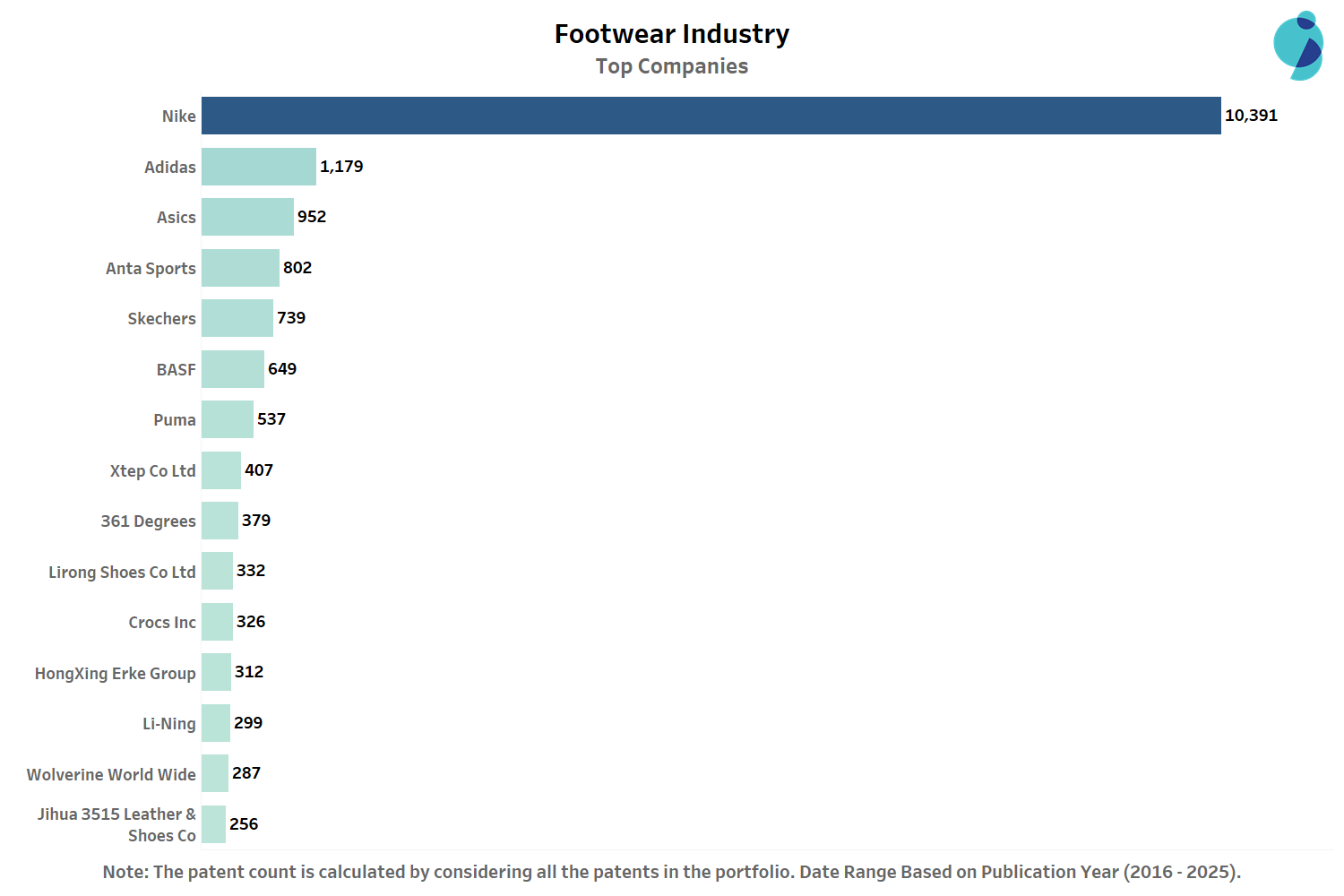
Nike dominates overwhelmingly with over 10,000 patents—nearly 9x more than any competitor. This reflects aggressive R&D across performance tech, materials, and manufacturing innovation.
Adidas holds second with ~1,200 patents, followed by Asics (950+) and Anta Sports (800+). Traditional players like Skechers, Puma, and BASF maintain mid-tier portfolios (500-700), while emerging Asian manufacturers—Xtep, 361 Degrees, Li-Ning—are building significant patent positions.
Even niche brands like Crocs (320+) show focused IP strategies in specialized segments.
Curious which technologies each company dominates? Want to identify competitive gaps and licensing opportunities?
Footwear patent activity is heavily concentrated in Asia, with China leading decisively at over 75,000 patents—commanding the lion’s share of global filings. This dominance is driven by massive investments in manufacturing innovation, smart footwear technology, and sustainable materials.
The United States holds strong with 17,000+ patents, focusing on performance engineering, automation, and branded innovation. South Korea and Japan collectively contribute over 11,000 patents, excelling in advanced materials and precision manufacturing.
Europe remains a significant player with over 7,500 patents (EPO), emphasizing quality, sustainability, and design innovation. Emerging activity in Taiwan, Brazil, and Italy signals that footwear R&D is becoming increasingly global and specialized.
Curious which countries dominate specific technology areas? Want to know where your competitors are filing and why?

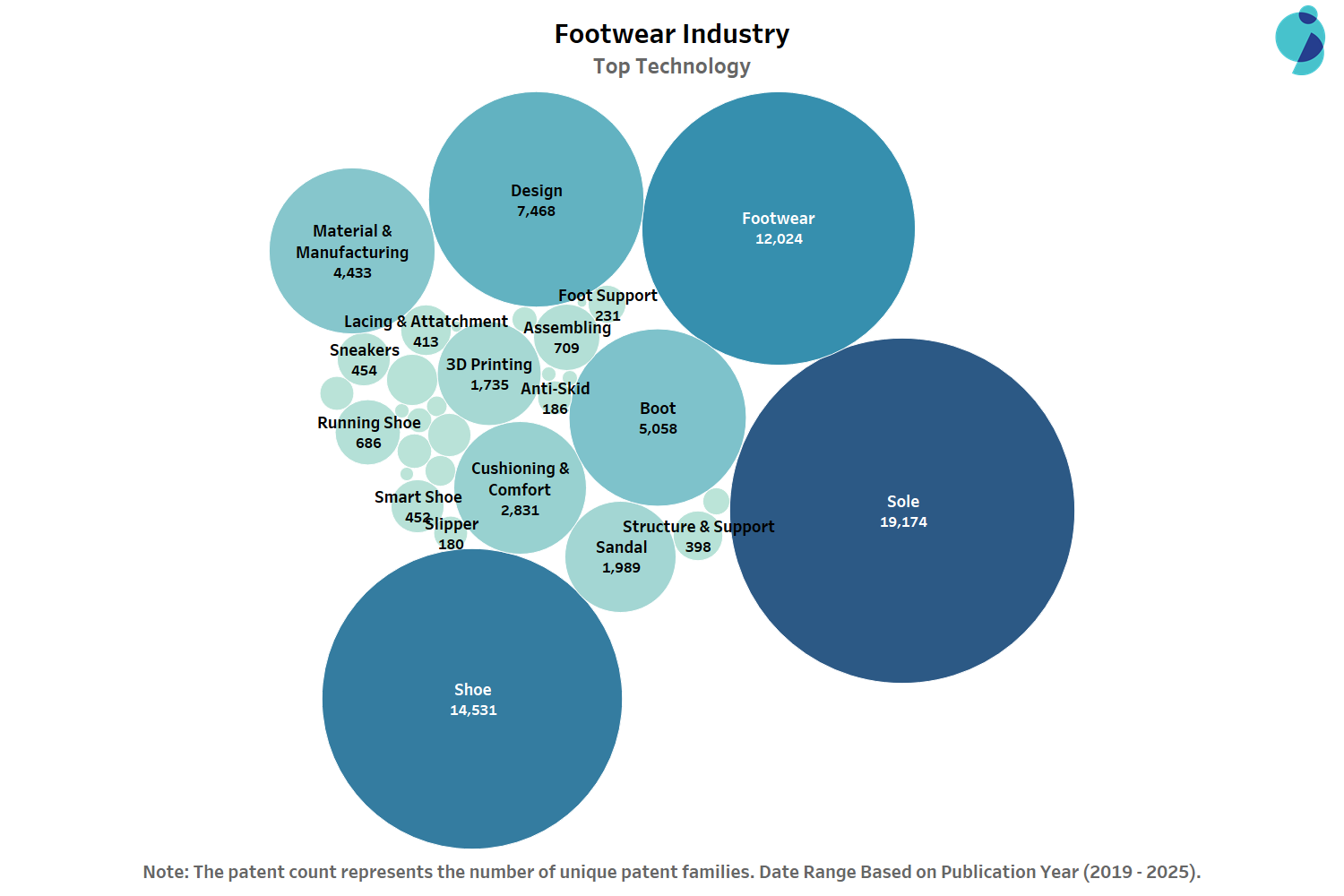
Patent activity reveals distinct innovation priorities across footwear technology. Sole technology dominates with over 19,000 patents, followed closely by Shoe (14,500+) and Footwear (12,000+) categories—reflecting intense competition in foundational performance and comfort engineering.
Design innovation commands over 7,000 patents, while Material & Manufacturing exceeds 4,400 patents, highlighting the industry’s push toward sustainable materials and advanced production methods. Boots (5,000+) and Cushioning & Comfort (2,800+) represent significant specialized segments.
Emerging tech areas show strategic focus: 3D Printing (1,700+) signals manufacturing transformation, Smart Shoes (450+) reveal connected footwear ambitions, and Running Shoes (680+) demonstrate performance category intensity.
Curious which companies lead in specific technology domains? Want to identify white-space opportunities in high-growth segments?